Sights · No. 05
Nanjing Museum: a morning among 400,000 objects
One of China's great museums, free with a reservation and closed on Mondays. What to see in three hours, how to book, and what to do if the slots are gone.
The Nanjing Museum was founded in 1933 as one of the first modern museums in China and remains one of the country's largest. Its collection runs from Neolithic jade to Republican-era painting, across a complex that includes a replica of a Republican street and a dedicated art gallery.
Getting in
Entry is free but requires a timed reservation, usually through WeChat with your passport. The daily cap is real, especially at weekends and during school holidays. Book two to four days ahead.
The booking flow is the usual Chinese mini-program: search the museum's official account, choose a date and time slot, enter your passport number exactly as it appears, and submit. You will get a QR code; screenshot it. At the gate, staff scan the code and check the passport name. If your name has spaces or hyphens, copy it the same way every time — a mismatch is the most common reason a booking fails at the door.
The museum is closed on Mondays, along with most of the city's museums. Do not build a Monday around it.
What is actually inside
The collection is broad, but four areas are worth your time:
- The history galleries cover the region from Neolithic settlement through the Six Dynasties. This is the best context for everything else you will see in Nanjing, including the wall and the Ming tombs.
- The porcelain and ceramics galleries hold Ming and Qing pieces, including imperial wares. Even without a ceramics vocabulary, the glazes are the pleasure.
- The painting and calligraphy galleries are quiet and beautiful; the hanging scrolls rotate, so what you see depends on the season.
- The Republican-era street in the basement is a reconstruction of 1930s Nanjing: shopfronts, signage, a cinema. It is theatrical, and children love it.
There are also folk-art, jade, bronze and special exhibition galleries. You cannot see them all, and trying will ruin the visit.
If you have three hours
Start with the history galleries on the ground floor, which take you through the region's archaeology and dynastic history in a logical sequence. The highlight is the Han and Six Dynasties material: bronzes, ceramics and tomb figures that give context to the city's earliest layers.
Then go up to the painting and calligraphy galleries. Even without expertise, the hanging scrolls and album leaves are beautiful, and the rooms are usually quiet.
Finish in the basement, where a reconstructed Republican-era street gives a sense of Nanjing in the 1930s. It is a little theatrical, but children like it and it makes the history concrete.
If you have one hour
Skip the chronological galleries and go straight to the special exhibitions, which rotate through the collection's best pieces. Check the museum's website or ask at the desk for what is on. The folk-art gallery is also a good short visit.
One hour is enough for one gallery and the shop, not for the museum. If that is all the time you have, choose the special exhibition and leave the permanent collection for another trip.
If the slots are gone
The museum releases a limited number of same-day reservations, and cancellations appear in the app, especially in the morning. Try at opening time. If it is still full, the alternatives are good:
- Six Dynasties Museum — smaller, newer, beautifully designed, and the best introduction to the city's earliest layers.
- Nanjing Municipal Museum at Chaotian Palace — a compact collection in a Ming palace complex, usually quiet.
- The City Wall Museum — free with a reservation, and the right background for the wall.
None replaces the Nanjing Museum's scale, but each is a proper museum rather than a consolation prize.
Practicalities
- The museum is at 321 Zhongshan East Road, next to the Ming Palace ruins.
- There is a café and a shop; the café is adequate, not memorable. The shop is better than average for gifts.
- Lockers are available at the entrance. Large bags are not allowed in the galleries.
- Photography is allowed without flash in most rooms; some special exhibitions prohibit it.
- Security is airport-style. Allow ten minutes at the entrance, more at weekends.
- Wheelchairs are available at the desk; lifts connect the floors.
Pairing it with the city
The museum sits between the old city and Purple Mountain, which makes it a good rainy-day choice or a bridge between the two. The Ming Palace ruins are next door: a grassy site with a few reconstructed gates, free and usually empty. It is not a headline sight, but it explains the scale of the Ming capital.
For lunch, walk west along Zhongshan East Road toward the old city, or take the metro one stop to Daxinggong, where the backstreets have noodle shops and dumpling houses. The museum café is convenient but not a reason to stay.
The building itself
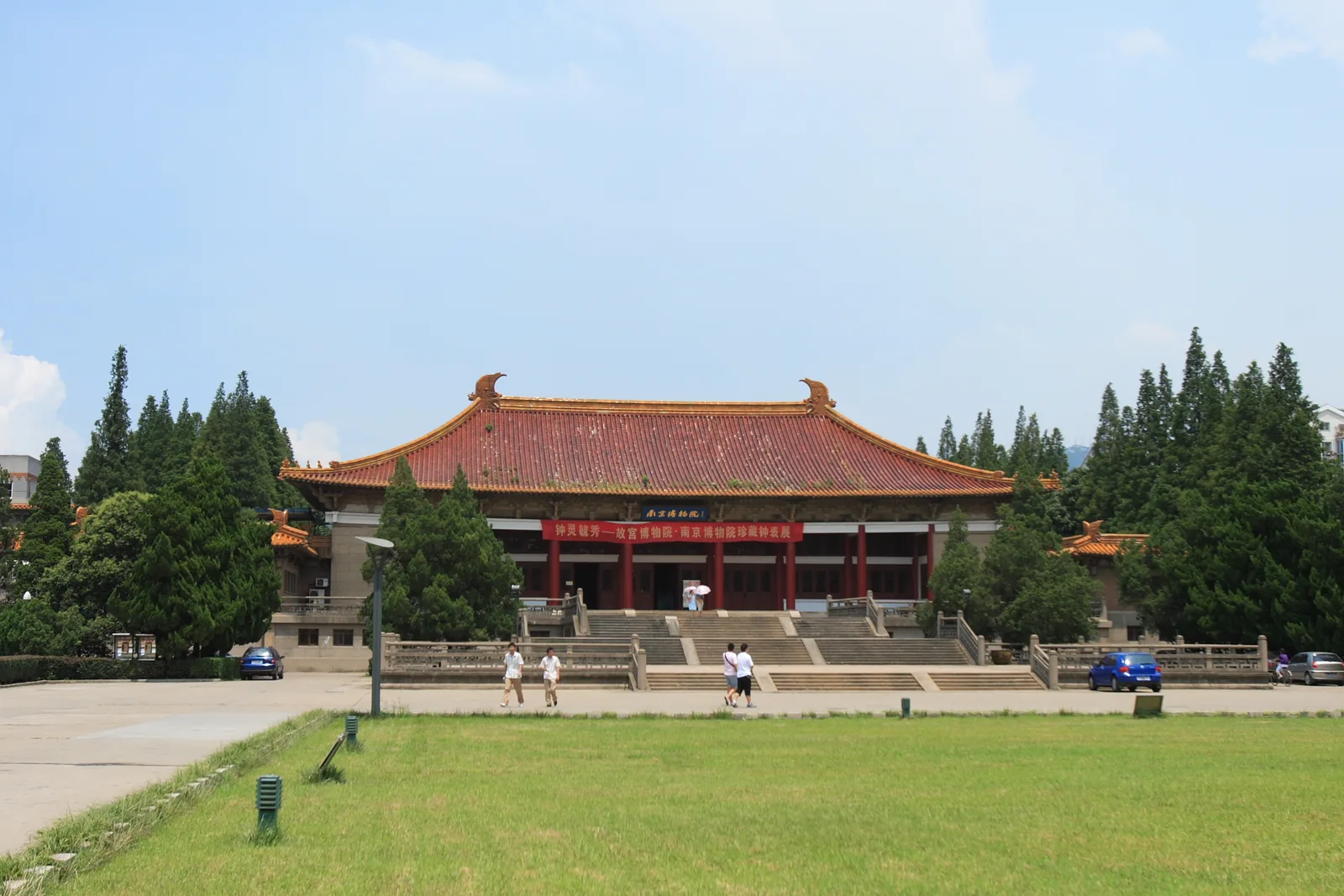
The main hall is a 1930s structure with a tiled roof and a long approach, built as a national museum and still one of the best pieces of Republican-era architecture in the city. The scale is deliberate: you are meant to feel small before you see anything.
The newer wings are less distinguished, but they hold the crowds. Start in the old hall, then work outward.
How to see it without exhaustion
The museum is enormous, and trying to cover it will ruin the day. Pick two or three galleries — the ceramics, the bronze, the Republican-era paintings — and leave the rest. The basement displays are quieter and often better.
Go on a weekday afternoon, when school groups have gone. Allow three hours, not five, and sit down halfway through. The café is a decent place to reset before the second gallery; the visit is better as two halves than one long march.
The Nanjing Museum is the one sight in the city where a reservation is worth rearranging your day for. Everything else can be swapped; this cannot.
Read next