Sights · No. 04
Nanjing's city wall: how to walk it
Thirty-five kilometres of Ming brick, with four good sections and one obvious choice for a short visit. A section-by-section guide to the wall as a walk.
Nanjing's wall is the longest surviving ancient city wall in China and one of the largest ever built. It was constructed between 1366 and 1393 under the Ming founder, using bricks stamped with the names of the makers and the regions that supplied them — an early quality-control system.
The four sections worth knowing
Zhonghua Gate to Dongshuiguan. The classic. Four kilometres of wall above the old town, with the city on one side and rooftops on the other, ending at Dongshuiguan. Start at Zhonghua Gate.
Xuanwu Gate to Jiefang Gate. The northern stretch, along Xuanwu Lake, with water on one side and the city on the other. Quieter, greener, and good at sunset. Access at Xuanwu Gate, near Xuanwumen metro station.
Shence Gate. A smaller section in the north-east, near the lake and the old administrative quarter. Short and uncrowded.
The eastern wall near the museum. A fragmentary stretch that connects to the Nanjing Museum area. Less continuous, but useful if you are already there.
Which section should you choose?
If you have one wall walk in you, choose Zhonghua Gate to Dongshuiguan. It has the best combination of height, old-town roofscape, gate architecture and access. It is also the busiest; start early or after 3pm.
Choose Xuanwu Gate to Jiefang Gate if you want quiet, water and a sunset. It is less about the city and more about the lake. The walking is easier and the crowds thinner.
Choose Shence Gate if you are staying near Xuanwu Lake and want twenty minutes on the wall without committing to a walk. It is a taste, not a meal.
Skip the eastern fragment unless you are already at the museum and curious. It explains the wall's extent but not its drama.
The classic walk, section by section
Start at Zhonghua Gate, the southern gate and the most impressive piece of military architecture on the wall. The barbican has layer after layer of walls and hidden troop chambers; walk through it before you climb. The City Wall Museum beside the gate is free with a reservation and explains how the wall was built, including the brick-stamp system.
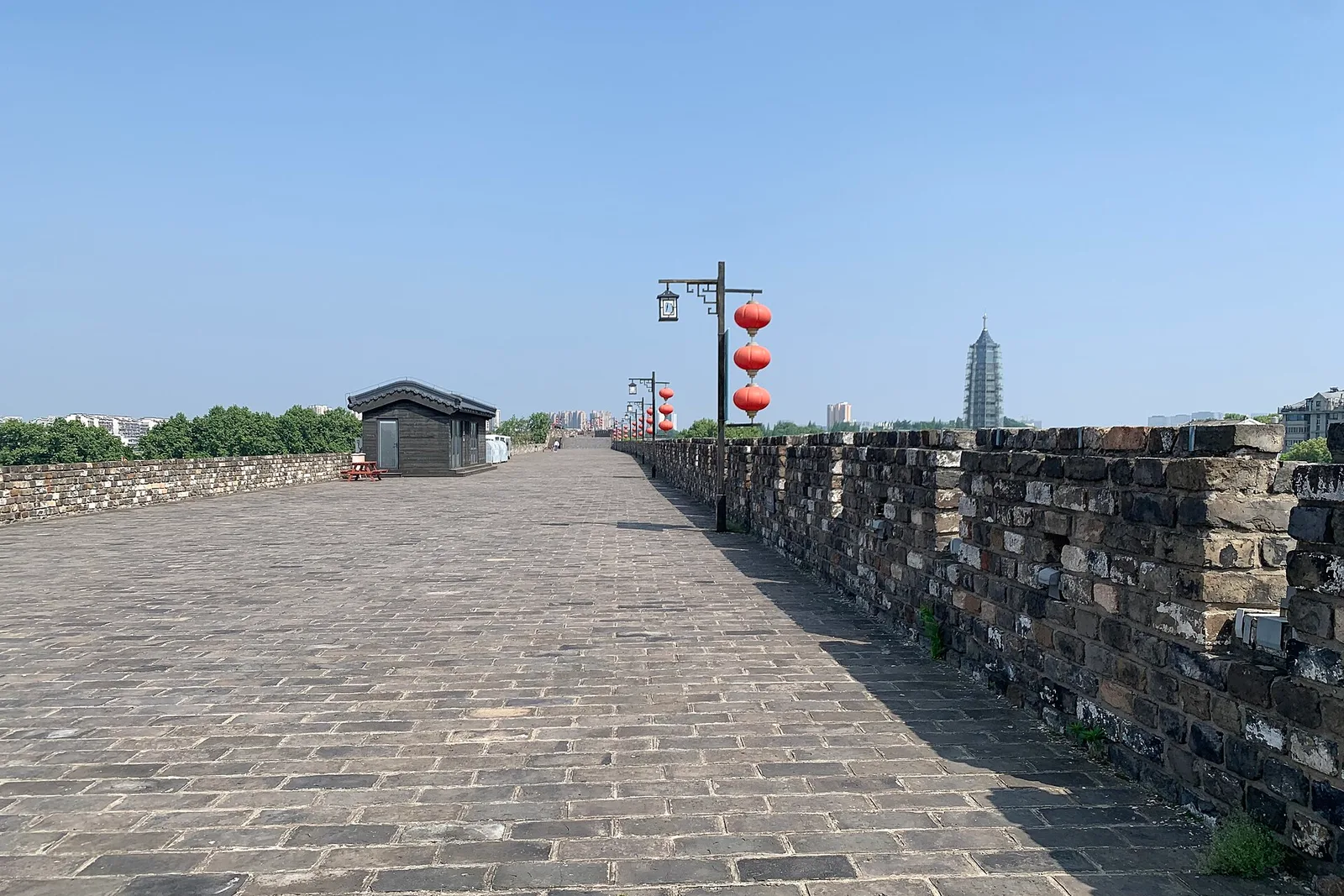
Climb onto the wall and head east. The first kilometre is the signature view: the old town's grey roofs on your right, the new city on your left, and the wall curving away in front. You pass several gates and watchtowers; most are closed, but the parapet and the brick stamps are the point.
The middle stretch is quieter and more residential. Look down into the lanes: courtyards, rooftop plants, laundry, the occasional cat. This is the part that makes the wall worth walking rather than photographing.
The walk ends near Dongshuiguan, on the east side. From there it is a taxi or a bus back to the centre; there is no convenient metro exit at this end. If you have energy, continue into the old town for lunch rather than turning straight around.
How long does it take?
The Zhonghua Gate to Dongshuiguan walk takes about 90 minutes at a steady pace without stops, two hours with the museum and photos. Add another hour if you walk back. The full circuit is a serious hike of eight to nine hours and not recommended in heat.
The Xuanwu Gate stretch is shorter in walking time but has fewer exits; check the map before you start, because leaving the wall midway is not always possible.
What the ticket covers
Individual sections sell tickets at the gate, usually ¥30–50. A combined ticket covers several sections and can be worth it if you plan to walk more than one. The City Wall Museum beside Zhonghua Gate is free with a reservation and closed on Mondays; it is the best introduction to the wall.
Opening hours shift with the season, usually around 8:30am to 5pm or 6pm, with last entry half an hour before closing. Check at the gate or on the official mini-program; do not trust a blog post from three years ago.
The best time
Early morning or the last two hours before closing. The wall is fully exposed: no shade, no water, no shelter. In summer, walk before 9am. In winter, bring a windproof layer — the wall catches the wind off the lake and the river.
Late afternoon is the photographer's hour: the light comes across the old town at a low angle and the brick turns warm. The trade-off is that you may be walked off the wall at closing, so start with enough time.
What to look for
The brick stamps. Look closely at the parapet and you will find characters pressed into the bricks: maker, region, date. Some sections have interpretive panels explaining the system. The wall's shape is also legible from above: it follows the old city's irregular outline, not a neat square.
The gates are the other detail. Each has a different plan — some with barbicans, some without — and the difference tells you where the Ming engineers expected attack. Zhonghua Gate is the most elaborate; Xuanwu Gate is the most scenic.
Access, exits and facilities
- Zhonghua Gate: Metro Line 1 to Zhonghuamen, then a five-minute walk. The main entrance and the museum are here.
- Xuanwu Gate: Metro Line 1 to Xuanwumen, then a short walk to the lake-side gate.
- Dongshuiguan: no nearby metro; taxi or bus back to the centre.
- Toilets are at the main gates, not along the wall. Carry water; there are few shops on top.
- Lifts are limited. The wall is not step-free, and the stairs are steep in places.
With children or older walkers
The wall is a hit with children — the height, the gates, the hidden chambers — but the drop is real and the parapet is low in places. Keep them close, especially on the crowded sections.
For older walkers, do the short out-and-back from Zhonghua Gate rather than the full four kilometres. The first kilometre has the best views and the easiest exit. Benches are scarce; plan a rest at the gate before you start.
Nearby food and pairing
Laomendong and the old town lanes are a ten-minute walk from Zhonghua Gate, which makes the classic walk a natural half-day: gate, museum, wall, lunch. Pair it with the Confucius Temple quarter in the evening, or with the wall history page if you want the background before you climb.
The wall is the single best way to understand Nanjing's geography. Walk one stretch and the rest of the city clicks into place.
Read next