Sights · No. 07
Purple Mountain: how the scenic area works
Four major sights on one mountain, spread over several kilometres. A guide to tickets, shuttles, the Sacred Way and the order that saves your legs.
Purple Mountain — Zijin Shan — rises east of the old city and holds Nanjing's most important cluster of sights. It is a mountain park rather than a single attraction, and the distances between its four headline sites are bigger than most visitors expect.
The four sights
Sun Yat-sen Mausoleum. The climb of 392 steps, the view, the modern history. Free with a reservation, and closed on Mondays.
Ming Xiaoling. The Ming founder's tomb, the Sacred Way of stone animals, the forest. Paid, and the largest single site on the mountain.
Meiling Palace. The Republican-era villa of Song Meiling, with the famous plane-tree "necklace" visible from above. Paid, small, and worth 45 minutes.
Linggu Temple. A quieter temple and the Beamless Hall, set among trees. Paid, and the best place on the mountain to sit down.
There is also a botanical garden, a music stage and several smaller tombs. Most visitors do not need them.
Understanding the layout
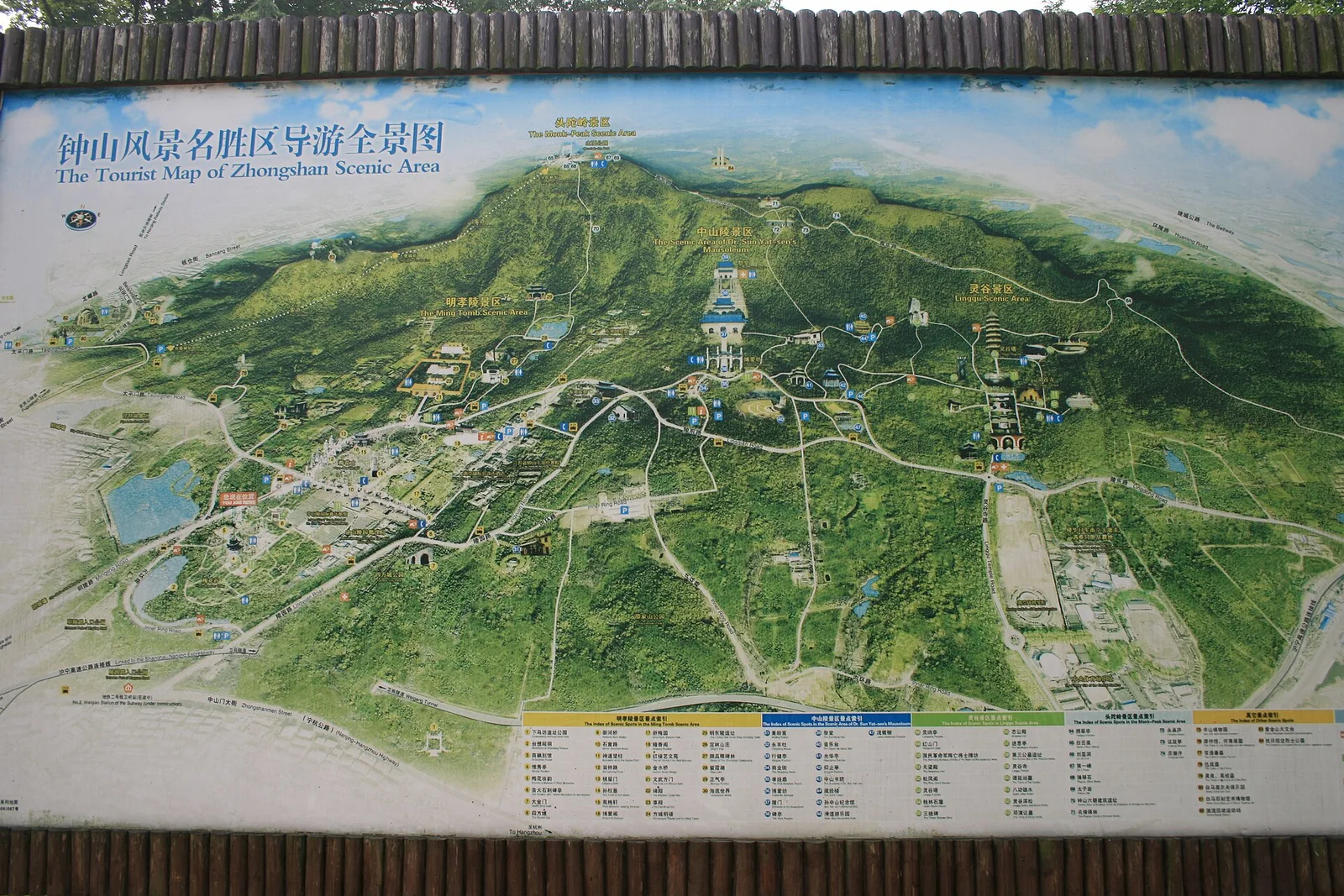
The scenic area has two clusters, and this is the thing to understand before you plan.
The western cluster is the mausoleum, Ming Xiaoling and Meiling Palace. They sit within a couple of kilometres of each other, linked by the scenic road and the shuttle. This is where the crowds are.
The eastern cluster is Linggu Temple, a few kilometres further east. It is quieter, greener and usually combined with the western sights by shuttle or taxi. Walking between the two clusters is possible but adds an hour and a lot of road.
The Sacred Way sits south of Ming Xiaoling, near the Muxuyuan metro station. Many visitors walk it first, then continue to the tomb.
The order that works
Start at the Sun Yat-sen Mausoleum at opening (8.30am). Climb, descend, then walk or take the shuttle to Ming Xiaoling. After lunch, Meiling Palace, then Linggu Temple if you still have legs.
The reverse order also works, but the mausoleum is the busiest site and the one most worth doing early. If you are visiting on a Monday, skip the mausoleum and start at Ming Xiaoling; the tomb and the Sacred Way are open, and the mountain is quieter.
A realistic full day: mausoleum 8.30–10.30, shuttle to Ming Xiaoling 10.45–1pm, lunch 1–2pm, Meiling Palace 2–3pm, Linggu 3.30–4.30pm. That is four sights, two shuttle rides and a lot of walking. It is doable in spring and autumn, punishing in summer.
The half-day version
Choose two. The best pair for a first visit is the mausoleum and Ming Xiaoling: one for the climb and the view, one for the tomb and the Sacred Way. If you have seen enough stairs, swap the mausoleum for Linggu and the Beamless Hall.
A half-day needs a 8.30am start and a taxi or shuttle back to the metro by 1pm. Do not add a third sight and expect to enjoy lunch.
The Sacred Way
The Sacred Way is the stone-lined approach to Ming Xiaoling, and it is the most atmospheric walk on the mountain. It begins with pairs of stone animals — lions, camels, elephants, horses and mythical beasts — standing and kneeling, then passes stone pillars and officials before turning toward the tomb.
The animals are best in low light, early or late, when the stone has some warmth and the tour groups are elsewhere. The whole walk is about 1.5 kilometres and flat; it is the easiest part of the mountain and the part children remember.
The Sacred Way is included with the Ming Xiaoling ticket. Enter from the south, near Muxuyuan, and walk north to the tomb rather than doing it in reverse.
Tickets and shuttles
Each sight sells its own ticket: Ming Xiaoling around ¥70, Meiling Palace around ¥30, Linggu around ¥35. A combined scenic-area ticket can save money if you plan to visit three or four; check what it covers before buying, because the mausoleum is free and not part of the calculation.
The shuttle buses are inexpensive and save 20–30 minutes of walking between sites; they run frequently in peak season and less so in winter. Buy the ticket at the stop or use the QR code; the drivers do not speak English, so have the stop name in Chinese.
Do not try to walk between all four. The road is long, the signage is inconsistent, and the mountain roads are not pedestrian-friendly. Taxis can drop you at the individual entrances but cannot drive through the scenic area.
Getting there and back
Metro Line 2 runs along the northern edge of the scenic area. Xiamafang is closest to the Sun Yat-sen Mausoleum; Muxuyuan is closest to Ming Xiaoling and the Sacred Way; Zhonglingjie is closest to Linggu.
From Xiamafang, it is a 15–20 minute walk to the mausoleum's Bo'ai Arch, or a short shuttle ride. At the end of the day, the shuttle back to the metro stops running earlier than the sights close; check the last bus time when you arrive, or book a taxi from the main gate.
When to go
Spring and autumn are ideal. Summer is hot and exposed; winter is quiet but bare. November is the peak for autumn colour and the busiest month on the Sacred Way.
Avoid weekends in cherry-blossom season and the first week of October. If you must go then, arrive at opening and leave by early afternoon.
Rain, heat and the mountain
In rain, the stone steps and the Sacred Way are slick. The mausoleum climb is exposed; Ming Xiaoling has more tree cover. If the rain is heavy, swap the mountain for the Nanjing Museum and come back on a clear morning.
In summer, do the mountain before 10am and after 4pm, and do not attempt all four sights. The shuttle is air-conditioned; the waiting stops are not. Carry more water than you think you need.
What to bring
Water, sun protection, comfortable shoes with grip, and a layer for the wind. Food options on the mountain are limited and overpriced. There are toilets at each major sight.
Accessibility
The mausoleum's 392 steps are the main barrier; the view from the base is still worth the trip. Ming Xiaoling's main axis is relatively flat, but the tomb itself has stairs. Shuttles reduce the walking between sights, and taxis can reach the main gates. Linggu is the easiest of the four for limited mobility.
The mountain is not a place to tick off quickly. Pick two sights, do them properly, and leave the rest for another visit.
Read next